
Computer Aided Building Drawing Lab
Industry-ready training programs to boost technical and soft skills.

Electronics and Communication Engineering (ECE) is a dynamic and ever-evolving field that plays a crucial role in shaping our modern world. It encompasses the design, development, and maintenance of electronic equipment and communication systems. The scope of ECE is vast and continues to expand with technological advancements.
The learning scope of Electronics and Communication Engineering (ECE) is incredibly broad and multifaceted, designed to equip students with a deep understanding of how the modern technological world functions. It's a field that constantly evolves, requiring continuous learning throughout one's career.
Learning scope of ECE program will include Circuit Analysis, Electronic Circuits, Digital Electronics, Communication Systems, Microcontrollers and Microprocessors, VLSI Design, Wireless Communication, Antennas and wave propagation, Network & Security, Embedded System Design and IoT, Artificial Intelligence and Machine Learning and Professional electives with latest updated technologies.

The Career Progression in Electronics and Communication Engineering (ECE) in India is dynamic and offers diverse paths, largely influenced by specialization, continuous learning, and gaining practical experience. It's a field where initial roles often focus on technical tasks, gradually evolving into more specialized, leadership, or even entrepreneurial positions. The students are prepared to start their career as Engineer Trainee in the core companies and as Software developers and Network Engineers in IT companies.
To be a center of excellence in Electronics and Communication Engineering by fostering innovation in intelligent electronic systems, promoting interdisciplinary research, and upholding ethical practices to address global communication and automation challenges.
To provide the students with a strong foundation in the required sciences in order to pursue studies in Electronics and Communication Engineering.
PEO 2 :To gain adequate knowledge to become good professional in electronic and communication engineering associated industries, higher education and research.
PEO 3 :To gain adequate knowledge to become good professional in electronic and communication engineering associated industries, higher education and research.
PEO 4 :To prepare students to critically analyze existing literature in an area of specialization and ethically develop innovative and research oriented methodologies to solve the problems identified.
PEO 5 :To inculcate in the students a professional and ethical attitude and an ability to visualize the Electronics and Communication Engineering issues in a broader social context.
Apply knowledge of mathematics, natural science, computing, engineering fundamentals and an engineering specialization to develop the solution of complex engineering problems.
PO2: Problem Analysis:Identify, formulate, review research literature and analyze complex engineering problems reaching substantiated conclusions with consideration for sustainable development.
PO3: Design/Development of Solutions:Design creative solutions for complex engineering problems and design/develop systems/components/processes to meet identified needs with consideration for public health and safety, whole-life cost, net zero carbon, culture, society, and environment as required.
PO4: Conduct Investigations of Complex Problems:Conduct investigations of complex engineering problems using research-based knowledge including design of experiments, modelling, analysis & interpretation of data to provide valid conclusions.
PO5: Engineering Tool Usage:Create, select and apply appropriate techniques, resources and modern engineering & IT tools, including prediction and modelling recognizing their limitations to solve complex engineering problems.
PO6: The Engineer and The World:Analyze and evaluate societal and environmental aspects while solving complex engineering problems for its impact on sustainability with reference to economy, health, safety, legal framework, culture, and environment.
PO7: Ethics:Apply ethical principles and commit to professional ethics, human values, diversity and inclusion; adhere to national & international laws.
PO8: Individual and Collaborative Teamwork:Function effectively as an individual, and as a member or leader in diverse/multi-disciplinary teams.
PO9: Communication:Communicate effectively and inclusively within the engineering community and society at large, such as being able to comprehend and write effective reports and design documentation, make effective presentations considering cultural, language, and learning differences.
PO10: Project Management and Finance:Apply knowledge and understanding of engineering management principles and economic decision-making and apply these to one’s own work, as a member and leader in a team, and to manage projects and in multidisciplinary environments.
PO11: Life-Long Learning:Recognize the need for, and have the preparation and ability for i) independent and life-long learning ii) adaptability to new and emerging technologies and iii) critical thinking in the broadest context of technological change.
Design, develop and analyze electronic systems through application of relevant electronics, mathematics and engineering principles.
PSO2:Design, develop and analyze communication systems through application of fundamentals from communication principles, signal processing, and RF System Design & Electromagnetics.
PSO3:Adapt to emerging electronics and communication technologies and develop innovative solutions for existing and newer problems.
| S. No. | Course Code | Course Title |
|---|---|---|
| 1 | 24EEC111 | Electric Circuit Analysis (Integrated) Laboratory |
| S. No. | Course Code | Course Title |
|---|---|---|
| 1 | 24ECC211 | Electronic Devices and Circuits (Integrated) Laboratory |
| 2 | 24ECC212 | Digital System Design (Integrated) Laboratory |
| S. No. | Course Code | Course Title |
|---|---|---|
| 1 | 24ECC213 | Linear Integrated Circuits (Integrated) Laboratory |
| 2 | 24ECC214 | Analog and Digital Communication Systems (Integrated) Laboratory |
| 3 | 24ECC215 | Digital Signal Processing (Integrated) Laboratory |
| S. No. | Course Code | Course Title |
|---|---|---|
| 1 | 24ECC311 | Microprocessors and Microcontrollers (Integrated) Laboratory |
| 2 | 24ECC312 | VLSI Design (Integrated) Laboratory |
| S. No. | Course Code | Course Title |
|---|---|---|
| 1 | 24ECC313 | Embedded System and IoT Design (Integrated) Laboratory |
| S. No. | Course Code | Course Title |
|---|---|---|
| 1 | 24ECC411 | Wireless Communication (Integrated) Laboratory |
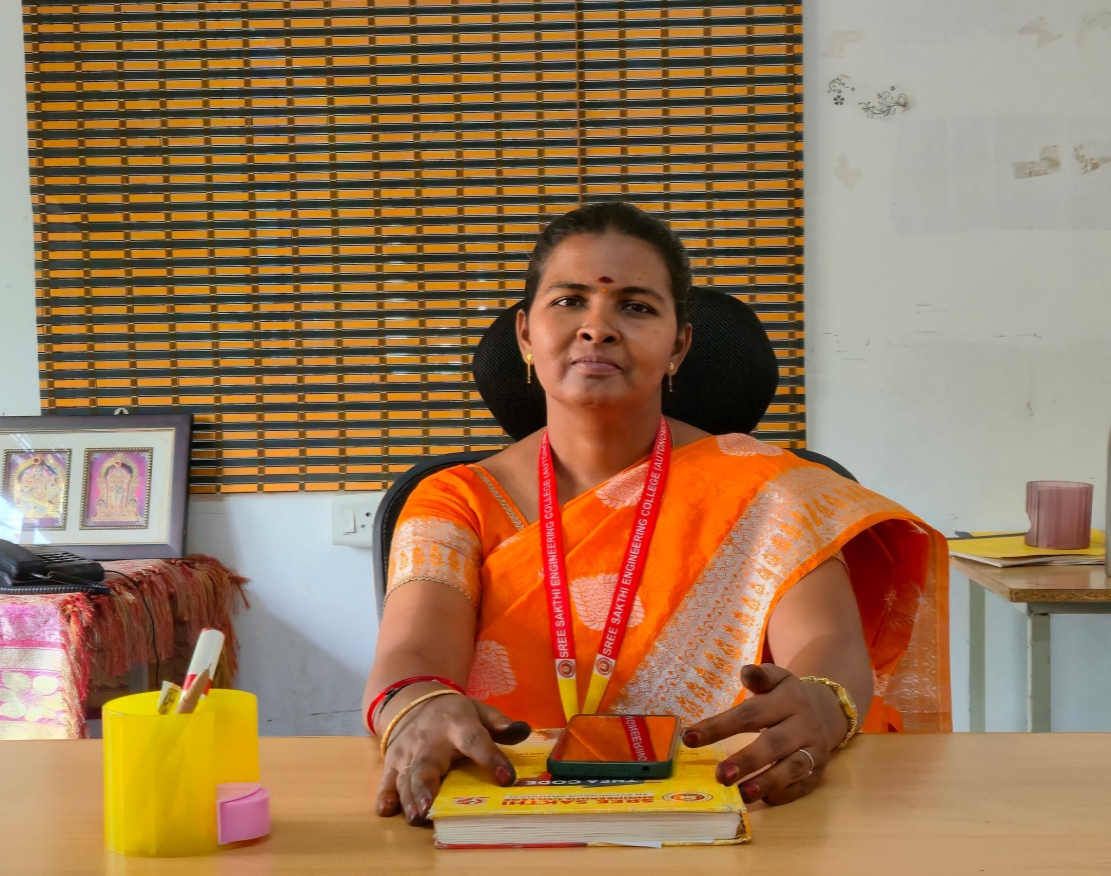
Dr. TAMILSELVI.P brings over 12 years of rich experience in teaching and research. has been instrumental in strengthening academic and research excellence through advanced laboratory development, industry-oriented learning, research mentoring, and interdisciplinary project guidance. Her expertise includes student mentoring, faculty development, technical workshops, and promoting emerging technologies beyond the curriculum. She actively contributes to research, professional activities, and industry–academia collaboration to enhance student competency and academic quality.
The research and academic activities:
“Education is not the learning of facts, but the training of the mind to think.”
— Albert Einstein.
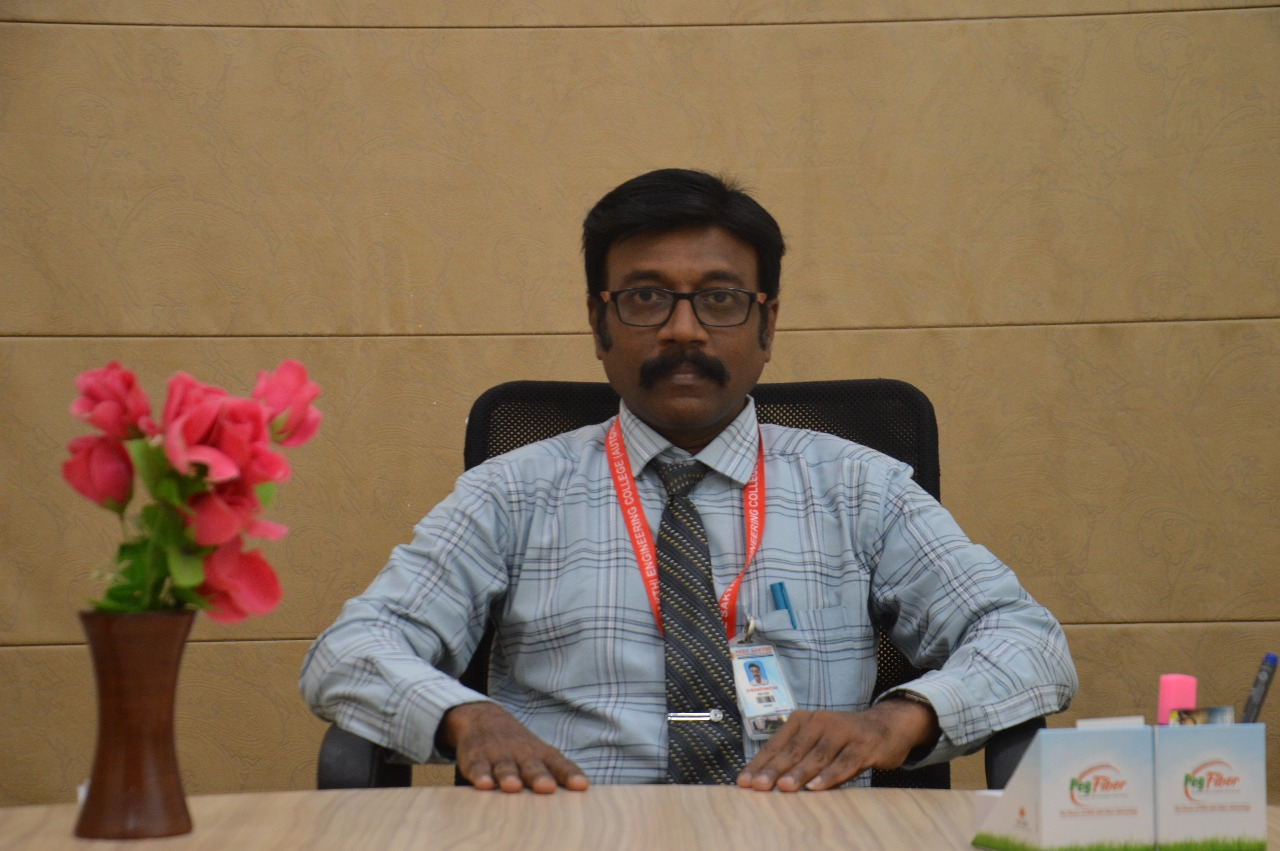
Dr. M.Karthikeyan brings over 25 years of rich experience in teaching and research. He has played a pivotal role in establishing the following academic and research facilities:
“The purpose of education is to make good human beings with skill and expertise… Enlightened human beings can be created by teachers.”
| Description / Year | 2026-2027 | 2025-2026 | 2024-2025 | 2023-2024 | 2022-2023 |
|---|---|---|---|---|---|
| No. of Faculty Members | 21 | 19 | 15 | 15 | 15 |
| No. of FDPs Attended | - | 20 | 66 | 63 | 32 |
| No. of Workshops / Seminars Attended | - | 30 | 27 | 20 | 13 |
| No. of Journal Publications | - | 10 | 9 | 7 | 5 |
| No. of Conference Presentations | - | 10 | 10 | 5 | 5 |
| No. of Patents Filed | - | 5 | 1 | 2 | - |
| No. of Books / Chapters Published | - | 5 | - | - | - |
| S.No | Faculty Name | Work Done | Achievement |
|---|---|---|---|
| 1 | Dr. M. KARTHIKEYAN | International Journal | Published research papers in 1 Journal |
| Patent | Published 2 patents | ||
| FDP | Attended 2 AICTE ATAL FDP | ||
| NPTEL | Completed 4 NPTEL courses | ||
| International Conference | Attended 1 International Conference | ||
| Awards | Best HOD Award | ||
| 2 | Dr.P. TAMILSELVI | Journal | Published a paper in 1 Journal |
| Patent | Published 3 Patent | ||
| FDP | Attended 5 FDP | ||
| NPTEL | Completed 1 NPTEL course | ||
| Seminar | Attended 1 Seminar | ||
| 3 | Mrs.A. KAVIYA | International Journal | Published research papers in 2 Journals |
| Patent | Published 2 patents | ||
| FDP | Attended 5 FDP | ||
| NPTEL | Completed 1 NPTEL courses | ||
| International | Attended 1 International Conferences | ||
| Conference | |||
| 4 | Mrs.K. GAYATHREE | International Journal | Published research papers in1 Journals |
| Patent | Published 3 Patent | ||
| FDP | Attended 3 FDP | ||
| NPTEL | Completed 1 NPTEL course | ||
| Seminar | Attended 1 Seminar | ||
| 5 | Ms.J. SWORNA JO LIJHA | International Journal | Published research papers in1 Journals |
| Patent | Published 2 Patent | ||
| FDP | Attended 3 FDP | ||
| NPTEL | Completed 3 NPTEL courses | ||
| 6 | Ms.C. SUGANYA | Patent | Published 1 Patent |
| FDP | Attended 1 FDP | ||
| 7 | Mr.J. SAMUEL | International Conference | Attended 3 |
| FDP | Attended 2 FDP | ||
| 8 | Mrs. RASIKAPRIYA R | FDP | Attended 3 FDP |
| 9 | Dr. C. KARTHIK SENDHILKUMAR | FDP | Attended 1 FDP |
| 10 | Mrs. T. POORNA SHREE | Journal | Published 2 papers in Journals |
| International Conference | Attended 1 International Conferences | ||
| patent | Published 1 paper | ||
| Book | Published 1 book | ||
| FDP | Attended 1 FDP | ||
| National Seminar | Attended 1 national Seminar | ||
| Workshop | Attended 1 Workshop | ||
| 11 | Mrs. D. SREEARTHI | FDP | Attended 1 FDP |
| 12 | Dr. JEYA S SHEMONA | International Journal | Published 1 papers in International Journals |
| International Conference | Attended 1 International Conferences | ||
| patent | Published 1 patent | ||
| Book/Book chapter | Published 1 book and two book chapters Where accepted | ||
| FDP | Attended 4 FDP | ||
| National Seminar | Attended 1 national Seminar | ||
| 13 | Dr. A. VIJAYALAKSHMI | Journal | Published 2 papers in Journals |
| International Conference | Attended 1 International Conferences | ||
| patent | Published 3 patent | ||
| FDP | Attended 1 FDP | ||
| NPTEL | Completed 2 NPTEL courses |
| S.No. | Name of the Faculty | Designation | Qualification | Specialization |
|---|---|---|---|---|
| 1 | Dr.SHANTHI I | Professor | Ph.D | Image Processing |
| 2 | Dr.KARTHIKEYAN M | Professor & Head | Ph.D | Power Systems Engineering |
| 3 | Dr.TAMILSELVI P | Associate Professor | Ph.D | Wireless Sensor Networks |
| 4 | Dr.JEYA.S.SHEMONA | Associate Professor | Ph.D | Image Processing |
| 5 | Dr.VIAYA LAKSHMI A | Associate Professor | Ph.D | Communication Systems |
| 6 | Ms.THIRUKKANI N | Assistant Professor | M.E | VLSI Design |
| 7 | Ms.JAMUNA R | Assistant Professor | M.E | VLSI Design |
| 8 | Ms.ANURADHA R | Assistant Professor | M.E | Communication Systems |
| 9 | Mr.SAMUEL J | Assistant Professor | M.E | Digital Communication And Networking |
| 10 | Mr.PRASANNAN N | Assistant Professor | M.E | Applied Electronics |
| 11 | Ms.GAYATHREE K | Assistant Professor | M.E | VLSI Design |
| 12 | Ms.KAVIYA A | Assistant Professor | M.E | VLSI Design |
| 13 | Mr.VINOTHKUMAR K | Assistant Professor | M.E | Applied Electronics |
| 14 | Ms.RASIKA PRIYA R | Assistant Professor | M.E | Applied Electronics |
| 15 | Ms.SWORNA JO LIJHA J | Assistant Professor | M.E | Communication Systems |
| 16 | Ms.SREE ARTHI D | Assistant Professor | M.E | Communication Systems |
| 17 | Mr.KARTHICK SENTHILKUMAR C | Assistant Professor | M.E | Communication Systems |
| 18 | Ms.POORNA SHREE T | Assistant Professor | M.E | VLSI Design |
| S.No | Name of the Equipment | Quantity |
|---|---|---|
| 1 | DSO 50 MHz | 15 Nos |
| 2 | Arbitrary Function Generator/ signal Generator 3 MHz | 15 Nos |
| 3 | Standalone desktops PC | 40 Nos |
| 4 | Power Supplies (0 – 30V/3A)(0-30V/3A)(0-5V/3A) (+/-15V) | 15 Nos |
| 5 | IC Tester | 5 Nos |
| S.No | Name of the Equipment | Quantity |
|---|---|---|
| 1 | DSO 50MHz | 15 Nos |
| 2 | Arbitrary Function Generator/ signal generator 3 MHz | 15 Nos |
| 3 | Power Supplies (0 – 30V/3A)(0-30V/3A)(0-5V/3A) (+/-15V) | 40 Nos |
| 4 | Digital LCR Meter | 15 Nos |
| S.No | Name of the Equipment | Quantity |
|---|---|---|
| 1 | CRO/DSO (30 MHz) | 15 Nos |
| 2 | Signal Generators / Function Generators (3 MHz) | 15 Nos |
| 3 | SPICE Simulator | 40 Nos |
| 4 | Standalone desktops PC | 15 Nos |
| 5 | Dual Regulated Power Supplies (0-30 v) | 15 Nos |
| S.No | Name of the Equipment | Quantity |
|---|---|---|
| 1 | IC Trainer kit | 15 Nos |
| 2 | IC Tester | 5 Nos |
| 3 | Standalone desktops PC with HDL software | 40 Nos |
| S.No | Name of the Equipment | Quantity |
|---|---|---|
| 1 | Trainer Kits for AM, FM, PCM, PAM,PPM,PWM | Each 2 Nos |
| 2 | Trainer Kits for ASK, FSK and PSK | Each 2 Nos |
| 3 | CRO/DSO (30 MHz) | 15 Nos |
| 4 | Signal Generators / Function Generators (3 MHz) | 15 Nos |
| 5 | MATLAB or equivalent open source software package for simulation Experiments. | 40 Users |
| 6 | Standalone desktops PC | 40 Nos |
| S.No | Name of the Equipment | Quantity |
|---|---|---|
| 1 | INTEL based desktop PC with min. 8GB RAM and 500 GB HDD, 17” or higher TFT Monitor, Keyboard and mouse | 40 |
| 2 | MATLAB software | 40 user |
| 3 | 3mm Audio jack connector to SP 7 patch cable | 5 Nos |
| 4 | DSP processor KIT- TMS320C50 | 5 user |
| 5 | DSO(30 MHz) | 5 Nos |
| 6 | Function Generator (3 MHz) | 5 Nos |
| S.No | Name of the Equipment | Quantity |
|---|---|---|
| 1 | Xilinx ISE/Altera Quartus/ equivalent EDA Tools | 40 User |
| 2 | Xilinx/Altera/equivalent FPGA Boards | 15 nos |
| 3 | Personal Computer | 40 nos |
| 4 | Cadence/ Mentor Graphics/Open Source equivalent CAD VLSI design tool | 15 users |
| 5 | DSO 50MHz | 15 Nos |
| 6 | Arbitrary Function Generator/ signal generator 3 MHz | 15 Nos |
| 7 | Power Supplies (0 – 30V/3A)(0-30V/3A)(0-5V/3A) (+/-15V) | 15 Nos |
| S.No | Name of the Equipment | Quantity |
|---|---|---|
| 1 | MATLAB or equivalent open source software package for Simulation Experiments. | 40 User |
| 2 | Standalone Desktops PC | 40 Nos |
| S.No | Name of the Equipment | Quantity |
|---|---|---|
| 1 | 8051 Microcontrollers | 20 nos |
| 2 | ARM Processor | 2 nos |
| 3 | Raspberry pi 2024 | 2 nos |
| 4 | Stepper Motor | 4 nos |
| 5 | CRO/DSO | 15 nos |
| 6 | Signal Generators/ Function Generators | 15 Nos |
| 7 | Standalone Desktops PC | 40 nos |
| 8 | THONNY or Equivalent open source software | 40 users |
| S.No | Date of association | Name of organization | Area of Activities | Contribution |
|---|---|---|---|---|
| 1 | 06.04.2025 | Axis Global Institute for Industrial Training | Academic, Research & Development Collaboration | Academic and Research |
| 2 | 11.12.2024 | FUJI Electric India Pvt. Ltd., | Academic, Research & Development Collaboration | Academic and Research |
| 3 | 23.11.2022 | VEI Technlogies | Academic, Research & Development Collaboration | Academic and Research |
Lorem ipsum dolor, sit amet consectetur adipisicing elit. Omnis a, cum voluptatum magni modi officia accusantium delectus ab maiores amet architecto natus doloribus libero deleniti vel distinctio earum provident corporis?

Industry-ready training programs to boost technical and soft skills.
Industry-ready training programs to boost technical and soft skills.
Industry-ready training programs to boost technical and soft skills.
Industry-ready training programs to boost technical and soft skills.
Lorem ipsum dolor, sit amet consectetur adipisicing elit. Omnis a, cum voluptatum magni modi officia accusantium delectus ab maiores amet architecto natus doloribus libero deleniti vel distinctio earum provident corporis?
| Description / Year | 2025–2026 | 2024–2025 | 2023–2024 | 2022–2023 |
|---|---|---|---|---|
| No. of Prizes | 15 | 66 | 35 | 31 |
| No. of Participants | 165 | 69 | 96 | 42 |
| Total | 180 | 135 | 131 | 73 |
| S.No | Name of the Student | Year/ Sem | Name of the Event | Organized by | Date | Participated/ Attended |
|---|---|---|---|---|---|---|
| 1 | Jermina Jasmine Nisha S Sridhanya Ks Naveen Kumar G Vishnu Priyan T |
II/IV | SYMPOSIUM-Project presentation | KARPAGAM INSTITUTE OF TECHNOLOGY | 6.2.2025 &7.2.2025 | Participated |
| 2 | Gopikrishnan A Kamalesh K Rahul A Rohith A Muneeshwaran M |
II/IV | SYMPOSIUM-IPL Auction | SNS ARTS AND SCIENCE COLLEGE | 19.2.2025 | Participated |
| 3 | Manju Priya Tharun Natchiyappan Rupatharashri Svitha |
III/VI | SYMPOSIUM-Technical quiz | RATHNAM COLLGEGE | 19.2.2025 | Participated |
| 4 | Suryaprakash | II/IV | WORKSHOP | SRI ESWAR ENGINEERING COLLEGE | 20.02.2025 TO 21.2.2025 | Participated |
| 5 | Poovazhagan K Hariprasath U Muthubalan R Gokul S Raja M Mohammed Riyaz N |
III/VI | SYMPOSIUM-Technical Event | COIMBATORE INSITUTE OF TECHNOLOGY | 21.2.2025 | Participated |
| 6 | Sasikumar S Akkash R |
II/IV | WORKSHOP | COIMBATORE INSITUTE OF TECHNOLOGY | 21.2.2025 | Participated |
| 7 | Kishore M Harini S Monisha S Sandhiya S |
II/IV | WORKSHOP | JAI SRI RAM ENGINEERING COLLEGE | 25.2.2025 | Participated |
| 8 | Archana Nisha Mohammed Nighamathuila Sridhanya |
II/IV | WORKSHOP | KPR COLLEGE OF TECHNOLOGY | 28.2.2025 | Participated |
| 9 | Ashai P Boobalan J Kanishkar K Mohanraj K Devendran D |
II/IV | SYMPOSIUM-Technical quiz | KPR COLLEGE | 28.2.2025 | Participated |
| 10 | Manju Priya Tharun Natchiyappan Rupatharashri Svitha |
III/VI | SYMPOSIUM-Project presentation | KPR COLLEGE | 28.2.2025 | Participated |
| 11 | Sathyaseelan Anumandhappan Gowtham Kasinathan |
III/VI | WORKSHOP | KPR COLLEGE OF TECHNOLOGY | 28.2.2025 | Participated |
| 12 | NitheeshV Rajesh.S Malarkodi.M Pooja.R Sakthimahewari.S |
III/VI | SYMPOSIUM-Technical Event | COIMBATORE INSITUTE OF TECHNOLOGY | 28.2.2025 - 1.3.2025 | Participated |
| 13 | Malarkodi M Sakthimaheshwari S Nitheesh V Rajesh S Pooja R |
III/VI | PROJECT EXPO | COIMBATORE INSTITUTE OF TECHNOLGY | 1.3.2025 | Participated |
| 14 | Balamurugan B Kannan V Mahendiran R |
II/IV | TECHNICAL QUIZ- Photography | KONGU ENGINEERING COLLEGE | 5.3.2025 | Participated |
| 15 | Archana J Nisha S |
II/IV | HACKATHON- TNWISE | KALAINGAR KARUNANITHI INSTITUTE OF TECHNOLOGY | 8.3.2025 | Participated |
| 16 | Rajamanu Sandhiyasri |
II/IV | WORKSHOP- Deep Learning | KARPAGAM COLLEGE OF ENGINEERING | 14.3.2025 | Participated |
| 17 | Dhanushram S | III/VI | TECHNICAL QUIZ | KARPAGAM COLLEGE OF ENGINEERING | 14.3.2025 | Participated |
| 18 | Dhanushram S Priyadharshan K Sathiyaseelan S Anumandappan K Pooja M |
II/IV | PAPER PRESENTATION | SRI RANGANATHAR ENGINEERING COLLEGE | 4.04.2025 | Participated |
| 19 | Archana J Harini S |
II/IV | PAPER PRESENTATION | SRI RANGANATHAR ENGINEERING COLLEGE | 4.04.2025 | Participated |
| 20 | Navaneeth Ks Niranjan M |
II/IV | TECHNICAL EVENT- Tech Crackers | SRI RANGANATHAR ENGINEERING COLLEGE | 4.04.2025 | Participated |
| 21 | Niranjan M Navaneeth Ks |
II/IV | TECHNICAL EVENT- Squid Game | SRI RANGANATHAR ENGINEERING COLLEGE | 4.04.2025 | Participated |
| 22 | Sandhiya K Dhakshna M Dhivya Bharathi D Kavi Bharathi R Pooja M Priyadharshini R Sasiprabha B |
II/IV | WORKSHOP- Virtual Reality AR AND VR | HINDUSTAN ENGINEERING COLLEGE | 4.4.2025 | Participated |
| 23 | Kamalesh Kumar T | II/IV | PAPER PRESENTATION | SARANATHAN COLLEGE OF ENGINEERING | 11.04.2025 | Participated |
| 24 | Dhivya Bharathi D Deepika B Devendharan R Javith Aslam J Johnharisan C Karthick R Kishore M Mohan Raj K Sarathi V Mohamed Nighmathulaah Sridhar V Sri Ramakrishna K Uthish Raj S Adhithya R Deepika V Bharath Kumar N S Gowthami T Sakthimaheshwari S Sathiyaseelan S Maha Vishnu J Mathan G Nivetha G Nivethitha A Subiksha C |
II/IV & III/VI | WORKSHOP- Quantum Computing For Scalable Big Data Insights And Next Generation AI Optimization | SRI KRISHNA COLLEGE OF ENGINEERING COLLEGE | 24.04.2025 | Participated |


| S.No. | Name of the Member | Role |
|---|---|---|
| 1 |
Dr.TAMILSELVI P HOD, Sree Sakthi Engineering College |
Chairperson |
| 2 |
Dr. R. VENKATESWARI PSG College of Technology |
University Nominee |
| 3 |
Dr. S. PREETHI Sathyabama Institute of Science and Technology |
Academic Expert |
| 4 |
Dr. D. DILEEPAN Vel Tech Rangarajan Dr. Sagunthala R&D Institute of Science and Technology |
|
| 5 |
Dr. T. GOWRISHANKAR Bosch |
Industry Expert |
| 6 |
Mr. M. PANTHALA RAJAN Salzar Electronics Limited (Plant-II) |
Alumni |
| S.No. | Faculty Name | Designation | Qualification | Specialization |
|---|---|---|---|---|
| 1 | Dr. SHANTHI I | Professor | Ph.D. | Image Processing |
| 2 | Dr. M. KARTHIKEYAN | Professor | Ph.D. | Power Systems |
| 3 | Dr. TAMILSELVI P | Associate Professor | Ph.D. | Wireless Sensor Networks |
| 4 | Dr. JEYA S. SHEMONA | Associate Professor | Ph.D. | Image Processing |
| 5 | Dr. M. ARUMUGARAJA | Associate Professor | Ph.D. | Embedded Systems and IoT |
| 6 | Ms. THIRUKKANI N | Assistant Professor | M.E. | VLSI Design |
| 7 | Ms. JAMUNA R | Assistant Professor | M.E. | VLSI Design |
| 8 | Ms. KAVIYA A | Assistant Professor | M.E. | VLSI Design |
| 9 | Mr. VINOTHKUMAR K | Assistant Professor | M.E. (Ph.D.) | Applied Electronics |
| 10 | Ms. RASIKA PRIYA R | Assistant Professor | M.E. | Applied Electronics |
| 11 | Ms. SWORNA JO LIJHA J | Assistant Professor | M.E. (Ph.D.) | Communication Systems |
| 12 | Ms. SREEARTHI D | Assistant Professor | M.E. | Communication Systems |
| 13 | Mr. C. KARTHICK SENDHIL KUMAR | Assistant Professor | M.E. | Communication Systems |
| 14 | Ms. RATHIKA R | Assistant Professor | M.E. (Ph.D.) | Communication Systems |
| 15 | Ms. DEEPIKA D | Assistant Professor | M.E. | Nano Science and Technology |
| 16 | Ms. YUVASRI P | Assistant Professor | M.E. (Ph.D.) | Embedded Systems and Technology |
| 17 | Ms. P. KANCHANA DEVI | Assistant Professor | M.E. | Applied Electronics |
| 18 | Ms. AHILAMARY M | Assistant Professor | M.E. | VLSI Design |
| 19 | Ms. K. G. DHARENI | Assistant Professor | M.E. | Applied Electronics |
| 20 | Ms. SOUNDARYA R | Assistant Professor | M.E. | Applied Electronics |
| PEOs | Statement |
|---|---|
| PEO1 | Graduates will have a strong foundation in Mathematics, Science, and Engineering fundamentals to enable them to deliver efficient solutions to challenging problems in Electronics and Communication Engineering and allied disciplines. |
| PEO2 | Graduates will attain successful professional careers by applying their engineering skills to develop innovative solutions and initiatives for Research & Development (R&D), industry, and higher education. |
| PEO3 | Graduates will engage in lifelong learning, adapt to evolving technologies, work in interdisciplinary domains to design innovative products for society, and become successful entrepreneurs. |
| POs | Statement |
|---|---|
| PO1 | Engineering Knowledge: Apply knowledge of mathematics, natural science, computing, engineering fundamentals, and an engineering specialization as specified in WK1 to WK4 to develop solutions for complex engineering problems. |
| PO2 | Problem Analysis: Identify, formulate, review research literature, and analyze complex engineering problems, reaching substantiated conclusions with consideration for sustainable development. |
| PO3 | Design/Development of Solutions: Design solutions for complex engineering problems and develop system components or processes that meet specified needs with appropriate consideration for public health, safety, and cultural, societal, and environmental factors. |
| PO4 | Conduct Investigations of Complex Problems: Use research-based knowledge and research methods, including the design of experiments, analysis and interpretation of data, and synthesis of information to provide valid conclusions. |
| PO5 | Modern Tool Usage: Create, select, and apply appropriate techniques, resources, and modern engineering and IT tools, including prediction and modelling, while recognizing their limitations in solving complex engineering problems. |
| PO6 | The Engineer and the World: Analyze and evaluate societal and environmental aspects while solving complex engineering problems, considering their impact on sustainability with reference to economy, health, safety, legal framework, culture, and the environment. |
| PO7 | Ethics: Apply ethical principles, commit to professional ethics, human values, diversity and inclusion, and adhere to national and international laws. |
| PO8 | Individual and Collaborative Team Work: Function effectively as an individual and as a member or leader in diverse and multidisciplinary teams. |
| PO9 | Communication: Communicate effectively and inclusively within the engineering community and society at large by preparing effective reports, design documentation, presentations, and clear instructions while considering cultural, language, and learning differences. |
| PO10 | Project Management and Finance: Apply knowledge and understanding of engineering management principles and economic decision-making, and apply these to one's own work as a member or leader in a team, and to manage projects in multidisciplinary environments. |
| PO11 | Life-Long Learning: Recognize the need for, and have the preparation and ability for (i) independent and lifelong learning, (ii) adaptability to new and emerging technologies, and (iii) critical thinking in the broadest context of technological change. |
| PSOs | Statement |
|---|---|
| PSO1 | Design, Development and Analysis of Electronic Systems: Design, develop, and analyze electronic systems through the application of relevant Electronics, Mathematics, and Engineering principles. |
| PSO2 | Communication System Design: Design, develop, and analyze communication systems through the application of fundamentals in Communication Principles, Signal Processing, RF System Design, and Electromagnetics. |
| PSO3 | Emerging Technologies: Adapt to emerging Electronics and Communication technologies and develop innovative solutions for existing and future engineering problems. |
| S. No. | Faculty Name | Total Count | Publication Details |
|---|---|---|---|
| 1 | KARTHIKEYAN M | 01 |
Real-Time Speed Limit Recognition and Speed Breaker
Detection for Adaptive Motor Speed Control in Autonomous
Vehicles Journal: Journal of Advance and Future Research Volume: 4, Issue 4, April 2026 |
| 2 | Dr. TAMILSELVI P | 02 |
1.
LeafInsightNet: A Deep Learning-Based Betel Leaf Disease
Classification Model with Real-Time Robotic
Detection Journal: Traitement du Signal Volume: 43, No. 1, February 2026, pp. 491–504 2. A Nano Topological Approach to Kidney Failure Diagnosis Using Nano Alpha Open Sets Journal: IJDDT Volume: 16, Issue 50S, 2026 |
| 3 | Ms. KAVIYA A | 01 |
Electricity Generation from Bio Waste Journal: IJIRT Volume: 12, Issue 8, January 2026 |
| 4 | SREEARTHI D | 01 |
AI-Based Ultrasonic Agricultural Protection System for
Intelligent Crop Safety Journal: International Research Journal of Modernization in Engineering Technology and Science (IRJMETS) Volume: 8, Issue 5, May 2026 |
| Value Added Courses | Teaching Methodologies | Laboratories | Centre of Excellence (CoE) |
|---|---|---|---|
| Drone Technology | Peer-to-Peer Learning | VLSI Laboratory | Robotics |
| Artificial Intelligence and Machine Learning | Project / Model-Based Assignments | Linear Integrated Circuits Laboratory | Fuji Electric Lab |
| Embedded System Design and IoT | Lab Demonstration | Communication Systems Laboratory | LabVIEW |
| PCB Design Using Proteus with Capstone Projects | Group Discussion | - | - |
| - | PowerPoint (PPT)-Based Teaching | - | - |
| - | Blackboard Teaching | - | - |
| - | Interactive Panel / Cloud-Based Teaching | - | - |
| Sl. No. | Name of the Equipment |
|---|---|
| 1 | Cathode Ray Oscilloscope (CRO) |
| 2 | IC Trainer Kit |
| 3 | IC Tester |
| 4 | Digital Storage Oscilloscope (DSO) |
| 5 | Signal / Function Generator (3 MHz) |
| 6 | Dual Regulated Power Supply (0–30 V) |
| 7 | Trainer Kits for AM, FM, Signal, PCM, PAM, PPM & PWM |
| 8 | Trainer Kits for ASK, FSK & PSK |
| 9 | Mixed Storage Oscilloscope |
| 10 | Regulated Power Supply (0–30 V / 3A) |
| 11 | DSP Processor Kit (TMS3206748 / TMS320C50) |
| 12 | 8086 Microprocessor Trainer Kit |
| 13 | 8051 Microcontroller Development Kit |
| 14 | 8255 PPI Interface Module |
| 15 | Traffic Light Interfacing Kit |
| 16 | ADC Module (ADC0808 / ADC0809) |
| 17 | DAC Module (DAC0808) |
| 18 | Stepper Motor with Driver (ULN2003) |
| 19 | Arduino Uno Boards |
| 20 | Raspberry Pi Kits (with SD Card & Power Supply) |
| 21 | Communication Modules (ZigBee / GSM / Bluetooth HC-05) |
| 22 | Relay Module (for Home Automation) |
| Sl. No. | Software | Type |
|---|---|---|
| 1 | Microsoft Office | Licensed |
| 2 | Windows 10 | Licensed |
| 3 | Turbo C++ | Open Source |
| 4 | Python | Open Source |
| 5 | Dev C++ | Open Source |
| 6 | Code::Blocks | Open Source |
| 7 | NI Multisim | Open Source |
| 8 | Scilab | Open Source |
| 9 | EDA Playground | Open Source |
| 10 | ngspice | Open Source |
| 11 | Keil µVision IDE | Open Source |
| 12 | GHDL | Open Source |
Copyrights © 2024. Sree Sakthi Engineering College
Designed by Webbitech